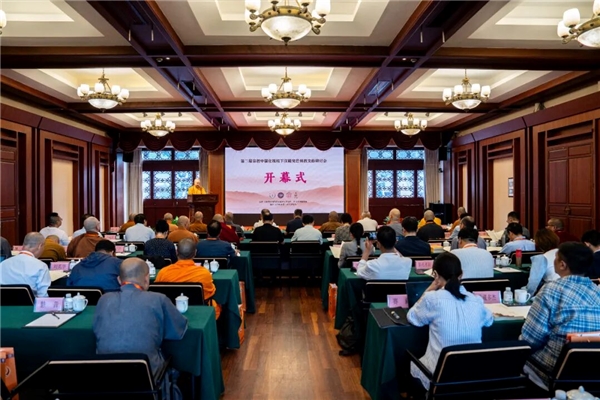
Nearly 50 experts, scholars, and Buddhist representatives from over 20 universities, research institutions, and provincial/municipal Buddhist associations attended the conference. These institutions include the Chinese Academy of Social Sciences, Peking University, Renmin University of China, Zhejiang University, Lanzhou University, China University of Political Science and Law, Minzu University of China, the Tibetan Academy of Social Sciences, Qinghai Minzu University, Hangzhou Buddhist Academy, the China’s Buddhist Academy of Mt. Putuo, China Advanced Institute of Pali Buddhism, and China Jiliang University. For the first time, Pali texts were incorporated into the research agenda of the symposium, creating a new framework for integrated research and exchange covering Buddhist literature in four major languages: Chinese, Tibetan, Sanskrit and Pali. The conference has helped to build a higher-caliber academic platform to advance research on multilingual Buddhist texts and theoretical studies on the Sinicization of religions.
The symposium featured keynote speeches alongside two parallel panel sessions, with over 40 academic papers presented in total. The research covered Buddhist scriptures in the four aforementioned languages, spanning multiple disciplines including philology, the history of Buddhist thought, Hetuvidyā (Buddhist logic), Vinaya studies, and digital humanities. The papers include meticulous textual research on canonical texts, etymological origins of terminology, and textual collation, as well as macro-level investigations into the evolution of Buddhist thought and the construction of academic systems. They embody a distinctive academic approach that combines textual criticism with theoretical interpretation and integrates micro-level textual analysis with macro-level thematic research.
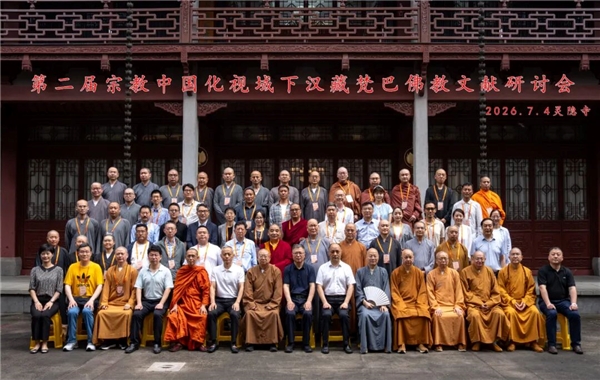
Participating scholars unanimously acknowledged the great academic significance and distinctive contemporary value of the conference. As the first national academic conference in China to conduct systematic comparative research on Chinese, Tibetan, Sanskrit and Pali Buddhist texts within a unified academic framework, it breaks the long-standing fragmented disciplinary boundaries between studies on Han, Tibetan and Theravada Buddhism, enabling in-depth dialogue across diverse Buddhist traditions and linguistic corpora on a shared platform.
The focused presentation and exchange of texts ranging from Sanskrit palm-leaf manuscripts and the Pāli Tipiṭaka to the Chinese Buddhist Canon and the Tibetan Kangyur and Tengyur have not only completed the holistic landscape of research on Chinese Buddhist literature but also offered viable practical approaches and paradigms for developing an indigenous Chinese academic system dedicated to multilingual Buddhist textual studies.
